
Read the code correctly
Our Sub-Zero threw an alarm and I'd panicked. He checked the model and serial to find the right service literature instead of ordering a board off a generic code chart.
Travis G. — Jensen RoadSub-Zero error codes are read by model and serial, never from a generic chart, because meanings shift across the 600 and 700 series. In Castro Valley a flashing "Service" indicator, a "Vacuum Condenser" reminder, or a door-ajar or over-temp alarm is verified against the rating plate near Columbia before any sensor or board is ordered. Call (510) 390-9712.
A flashing alarm in a Castro Valley Sub-Zero can point toward a sensor, fan, door event, control issue or temperature condition, but code meanings are not universal across every model generation. The safe path is to preserve the display state, record temperatures, photograph the model tag and avoid DIY electrical or refrigerant work. Use the phone link or online booking page quickly when the alarm is paired with rising food temperatures.
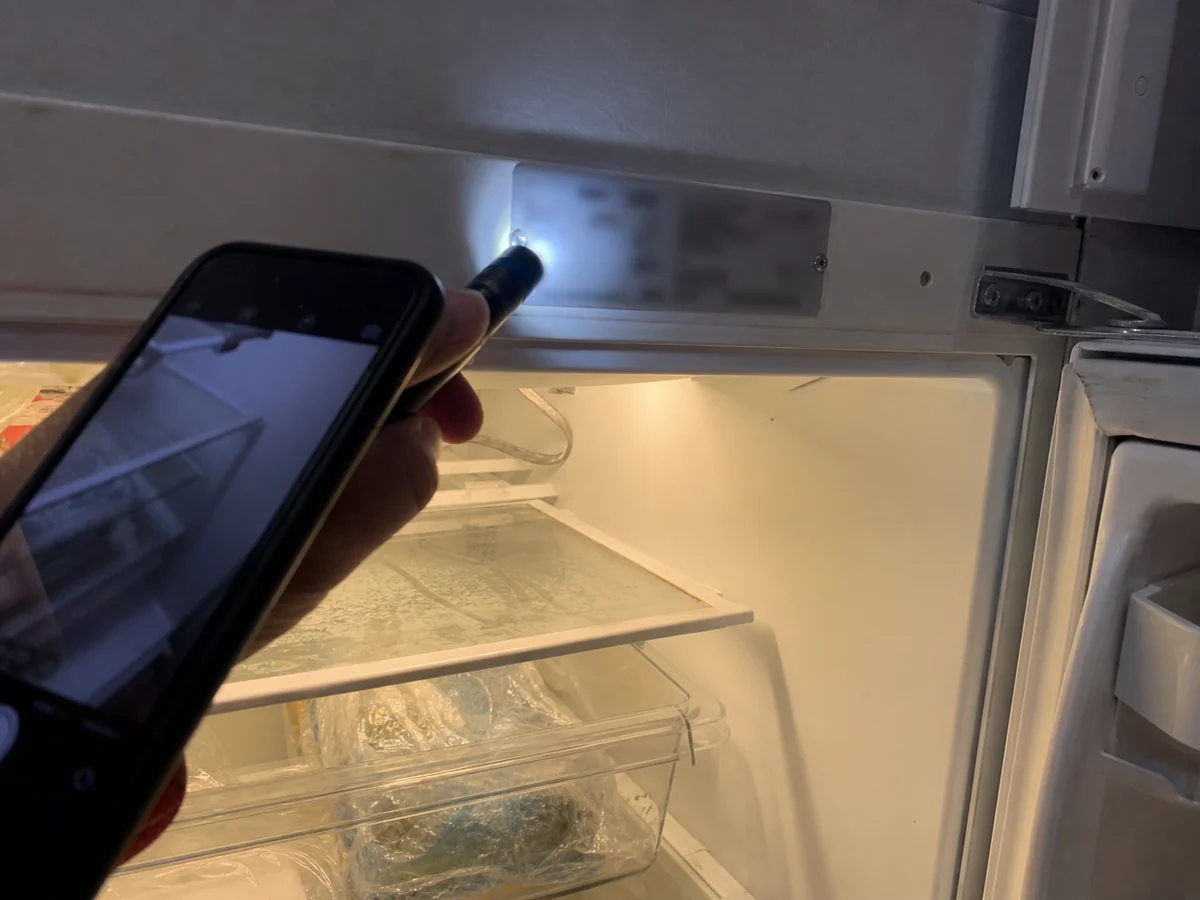
Codes list
Sub-Zero shows behaviors and indicators, not a fixed numeric chart; each is verified by model and serial before any part is ordered.
| Alarm / display behavior | What it usually points to | What to do |
|---|---|---|
| Flashing or solid "Service" indicator | A stored fault, a sensor reading out of range, or a control-board condition | Photograph the display, then verify by model and serial before any board is ordered |
| "Vacuum Condenser" reminder or unusually long runs | Restricted airflow; in hillside 94552 homes oak dust can pack the condenser in 6–9 months | Pull the lower grille, clean the visible coil, then re-check temperatures and runtime |
| Repeating door-ajar alarm | Door switch, hinge or a gasket that swells in East Bay marine-layer fog and breaks the seal | Confirm a full close and run a paper-drag test on the gasket before replacing a switch |
| Over-temp alarm after the door was open | Normal recovery, or a marginal sensor if the temperature does not settle | Let it run a full cycle, then re-probe; same-day if food is warming |
| Fresh-food side warm, freezer fine | Evaporator fan, frosted coil or a stuck air damper between compartments | Note both temperatures and book a diagnostic; do not keep clearing the alarm |
| Blank or frozen display / newer EC-style codes | Power, a control board or a harness connector; newer panels show generic codes | Check the outlet, then have the board and connectors metered; verify the code by model/serial |
These are general Sub-Zero behaviors for Castro Valley, 94546 and 94552; exact meanings are not universal across generations, so the cause is confirmed by model and serial before a part is ordered.
Customer reviews
Review signal from the wider appliance repair service network: 700+ customer reviews across platforms with a 4.9 average rating. Visible themes emphasize accurate Sub-Zero diagnosis, same-day routing when route capacity allows, careful cabinet protection and factory-authorized Sub-Zero OEM parts when replacement parts are needed.
Our Sub-Zero threw an alarm and I'd panicked. He checked the model and serial to find the right service literature instead of ordering a board off a generic code chart.
Travis G. — Jensen RoadThe code pointed several directions. He verified the actual sensor and airflow behavior first, then confirmed the board was fine. Saved an unnecessary part.
Inez M. — ColumbiaWhen the control board really did fail, he matched it by serial and used a genuine Sub-Zero part. Clear written explanation of what the alarm had meant.
Kyle B. — Briar RidgeSafety boundary
A homeowner can photograph the control display, write down compartment temperatures, confirm the door is fully closed, check whether the grille area is blocked and locate the model tag. Those steps are useful and safe when done without removing electrical covers or forcing components.
Control-board output tests, high-voltage checks, refrigerant diagnosis and sealed-system work belong to trained service. For Sub-Zero units, a false-positive alarm can come from airflow, door contact or sensor feedback, so replacing a board from a universal code chart is an expensive gamble.
If an alarm is paired with food temperatures above safe storage range, move food first and preserve the display evidence with a photo.
Diagnostic table
Code meanings are verified by model and serial before any part is ordered, because they are not universal across Sub-Zero generations.
| Symptom | Possible component | Confirmation test | False-positive to avoid | Repair path |
|---|---|---|---|---|
| Warm refrigerator alarm | Evaporator fan, thermistor, airflow, gasket | Temperature reading plus fan and frost pattern check | Assuming compressor failure from temperature alone | Confirm airflow before parts |
| Door alarm repeats | Door switch, hinge, panel alignment, gasket | Switch response and reveal/gasket contact | Replacing switch before checking panel fit | Adjust, seal or switch after proof |
| Display blank or erratic | Power, control board, harness | Outlet and board input/output tests | Ordering display board without power checks | Electrical diagnosis by technician |
| Freezer temp alarm | Defrost, fan, sealed system, door leak | Frost pattern and fan operation | Clearing alarm repeatedly | Follow freezer diagnostic sequence |
| Ice maker fault behavior | Fill valve, fill tube, sensor, temperature | Harvest cycle, water flow and freezer temp | Forcing rake or mold | Water path and ice maker test |
| Wine zone alarm | Sensor, fan, condenser, door contact | Upper/lower zone logged readings | Using one instant reading | Zone-specific diagnosis |
| Service indicator after reset | Historical fault or active sensor | Model-specific literature and stored condition | Generic code chart | Verify by serial before ordering |
Planning ranges and diagnostic paths are not final quotes; final scope depends on model and serial number, cabinet access, part availability and measured evidence.
Evidence
The right images preserve the state of the machine before it changes.

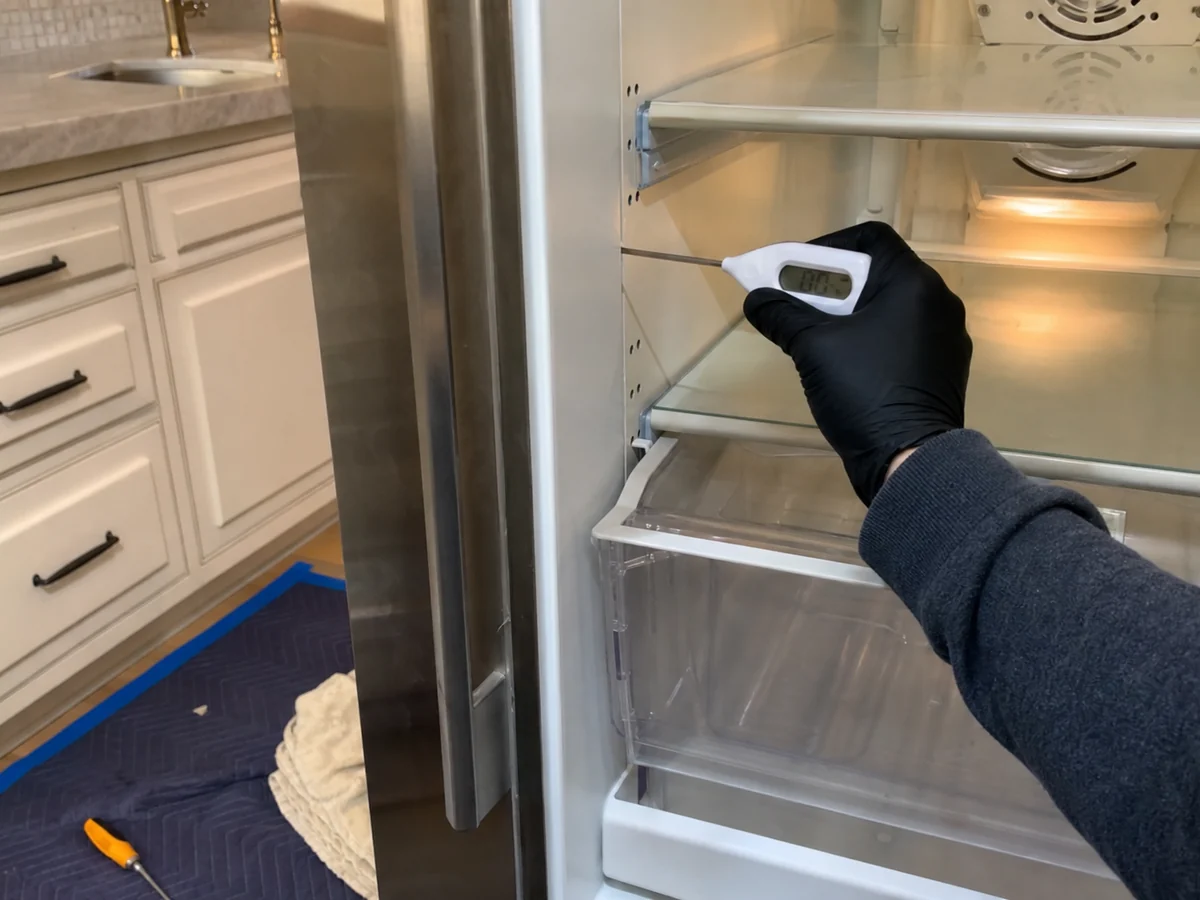

Model notes
Classic built-ins, Designer columns, PRO units, undercounter models and wine storage can all display alarms differently. On older units, service lights and beeps may not map cleanly to newer control language. On integrated columns, door contact and cabinet plane can create repeated alarms that look electronic until the reveal is measured.
For 94546 and 94552 homes, the best pre-visit evidence is not a guessed code definition. It is the model tag, a display photo, temperature readings and whether the unit was recently cleaned, reset or moved. That gives the technician a narrower starting point and helps avoid wrong-board ordering.
How-to
Preserve the evidence a technician needs before you clear the panel.
Before touching anything, capture the alarm or code exactly as shown.
Write down the fresh-food and freezer readings from the display or a thermometer.
Confirm the door is fully closed and the lower grille area is not blocked.
Move perishable food if temperatures are unsafe; repeated resets erase the history needed for diagnosis.
Cost table
Planning ranges for alarm-driven work; codes are verified by model and serial so a board is never replaced on a guess.
| Service / symptom | What's included | Castro Valley price range | Typical time |
|---|---|---|---|
| Alarm diagnosis | Read stored code by serial, confirm the real cause | $149–$235 | 45–90 min |
| Sensor / thermistor | Model-matched sensor after readings | $190–$430 | 1–2 hrs |
| Door switch / alignment | Switch test and panel-front reveal adjustment | $180–$420 | 1–2 hrs |
| Control board | Service-mode input/output testing, matched board | $320–$980 | 1–4 hrs |
Sub-Zero codes are not universal across generations, so the cause is confirmed by model and serial before a control board is ordered.
Quick facts
Self-contained Castro Valley facts with explicit prices, temperatures and intervals.
Before dispatch
The display state is often more useful than a long description. Use the phone link or online booking page if temperatures are rising.
Alarm FAQ
These answers stay inside safe homeowner checks.
On many Sub-Zero built-ins a service or clean-condenser indicator follows months of restricted airflow. In hillside 94552 homes, oak dust can pack the condenser in 6–9 months. Clean the visible grille, but if the light or warm temperatures persist, the condenser likely needs a full service behind the covers ($220–$420).
Indirectly. Marine-layer humidity can swell a gasket or reveal a door sitting slightly out of plane, which keeps a door switch from registering a clean close and repeats a door alarm. The fix is a reveal and gasket-contact check, not a board; diagnosis runs $149–$235 before any part.
Any alarm paired with rising food temperatures, a softening freezer or active water is same-day. A stable alarm with normal temperatures, often a sensor or door event, can be a scheduled diagnostic. Photograph the display and note both temperatures before resetting so the cause is not erased.
If food safety is not immediately at risk, photograph the display and note temperatures before clearing anything. Repeated resets can erase useful history.
They can be incomplete or model-specific. Treat any chart as a clue until the model, serial and service literature match.
Only if temperatures are stable and food safety is not in question. Record actual temperatures and move perishable food if the compartment is warming.